
One Model Answers Both What Happens Next and What to Do Now
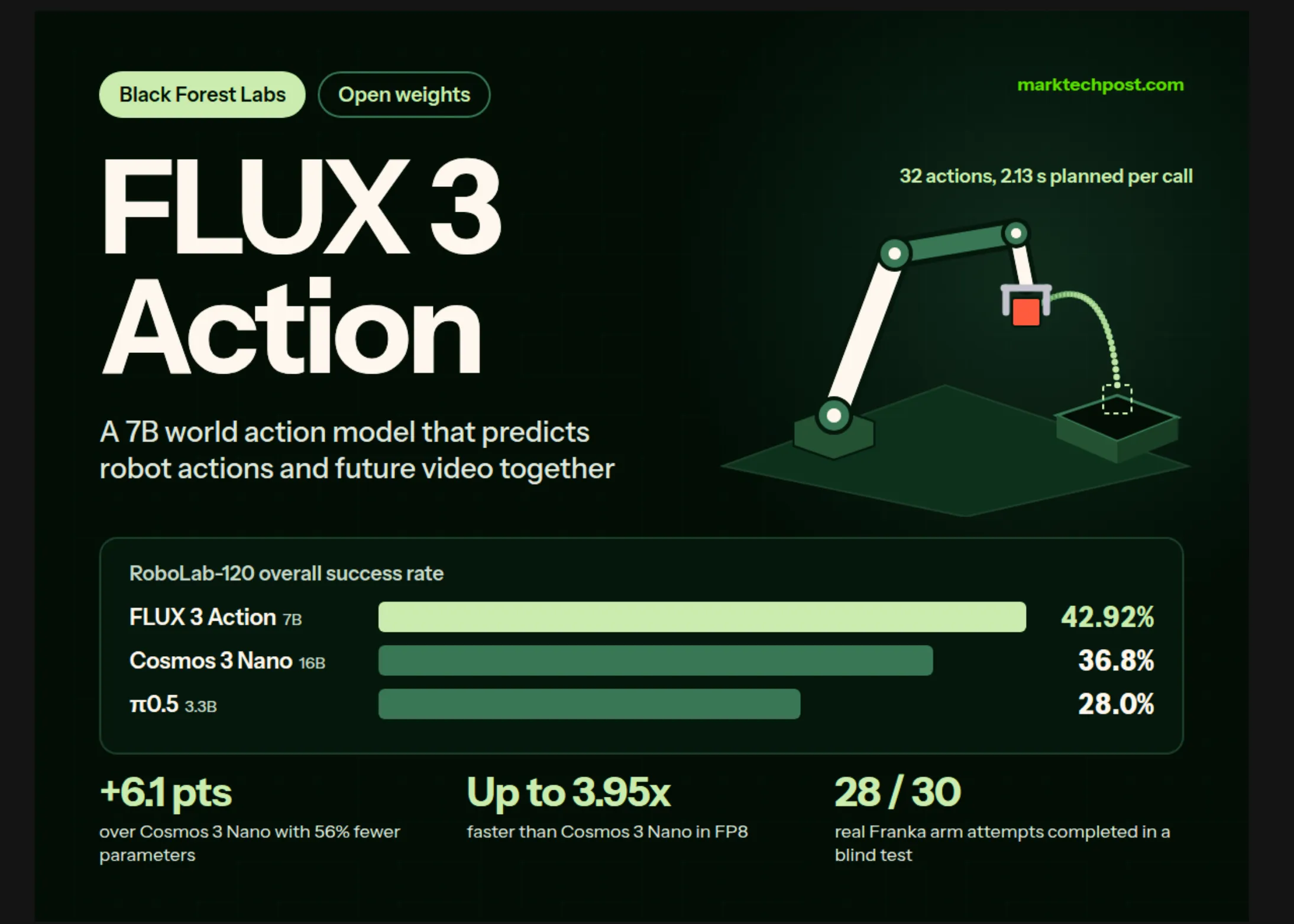
Black Forest Labs has released FLUX 3 Action, a 7B open-weights World Action Model for robot control. It takes camera frames, robot state, and a text instruction, converts them into tokens, and uses the FLUX 3 multimodal backbone to predict future video frames and the next chunk of robot actions together. For robotics systems, this addresses a persistent split: should a model focus on understanding how the environment will change, or simply emit the next control signal?
World action models generally gain from predicting future scenes because actions can be placed in a longer causal sequence, but video generation is computationally expensive. Vision-language-action models usually produce actions more directly and can be faster, though they may give up some explicit modeling of future states. FLUX 3 Action does not choose between the two. It shares a backbone between video and action tokens, then uses separate decoders for predicted frames and joint commands. That design explains its technical interest, but it also means deployment cannot be judged by the latency of an action head alone.
The Most Important Variable Behind the Lead Is Not the 7B Parameter Count
FLUX 3 Action reaches 42.92% task success on RoboLab-120, placing first. The comparison models score 36.8% for the 16B Cosmos 3 Nano, 28.0% for the 3.3B π0.5, 25.7% for the 14B DreamZero, and 7.2% for the 3B GR00T N1.6. The result gives FLUX 3 Action a 6.1-point lead over Cosmos 3 Nano with 56% fewer parameters, but it should not be reduced to the claim that a smaller model is simply better.
The more important evidence comes from the training ablation. Training on DROID alone stayed below 1% success. Under the same protocol, adding pretraining raised the result to 11.6%. FLUX 3 Action was pretrained on image, video, and audio data, with video accounting for more than 95% of training tokens. Midtraining then mixed 36.95% pretraining samples with 63.05% action-aligned video, covering game recordings, egocentric human hand video, handheld grippers, and teleoperation across 14 embodiments. The 7B size is therefore only the final capacity budget. The transferable behavior comes from learning how the world changes in broad video data before connecting that representation to an action space.
Distillation Lowers the Cost, but Puts the Trade-Off in the Deployer's Hands
BFL provides three DROID policy recipes that trade speed for quality. The base version uses four sampling steps with separate guidance settings of video CFG 4 and action CFG 1. The guidance-distilled version removes the second guidance pass, runs roughly 1.8 to 2 times faster, and improves success by 0.6 to 1.08 percentage points. The step-distilled version reduces sampling to a single step, increasing speed by 3.15 to 4 times but losing 3.51 to 4.32 percentage points in success.
This is not a deployment story in which faster is automatically better. It is a quality-budget decision. Each call returns 32 actions at 15 Hz, representing 2.13 seconds of motion. π0.5 returns one second per call, so BFL compares speed using real-time factor, the ratio between compute time and the duration of generated motion, rather than raw per-call latency. Against Cosmos 3 Nano in FP8, the base and guidance-distilled checkpoints are 1.52 to 3.95 times faster across consumer, workstation, and datacenter GPUs. The step-distilled checkpoint is 1.34 to 2.28 times faster than π0.5 on workstation and datacenter GPUs, but it is still slower on an RTX 5090. Hardware and numerical precision change the answer.
**Evidence block | Deployment threshold:** The DROID policy requires about 32 GB of GPU memory in BF16 on an H200. With FP8 quantization and text-encoder offload, it fits on 24 GB cards. Open weights therefore do not mean low-cost inference. The gains from compression must be evaluated together with the target GPU rather than inferred from parameter count alone.
The Real-Robot Signal Is Strong, but the Evidence Is Still Narrow
RoboLab-120 contains 120 tabletop tasks in Isaac Sim, with 10 trials per task on a DROID-style Franka setup. That benchmark establishes relative performance on a standardized task set, but it does not demonstrate general-purpose control across environments and hardware. In particular, gains from video-based world modeling in simulation may not transfer fully to real scenes with more complex lighting, friction, occlusion, and execution error.
The real-robot result is encouraging but limited. Positronic Robotics conducted a blind evaluation on a Franka arm using 10 DROID tasks and three attempts per task. FLUX 3 Action completed 28 of 30 attempts for 93.3%, compared with 27 for Cosmos 3 Nano, 20 for DreamZero, and 13 for π0.5. The 28-to-27 margin suggests that the simulated advantage was not completely lost on hardware, but 30 attempts are not a statistical guarantee for scaled deployment. For a technical lead, this is a signal to continue field validation, not an acceptance result.
Open Weights Do Not Mean the Model Can Directly Take Over the Robot
The openness of FLUX 3 Action mainly concerns its weights and deployment recipes, not unrestricted commercial use. The FLUX Kommunity License allows non-commercial use, which benefits research, prototyping, and internal validation, but a commercial product must resolve the licensing boundary first. For a team integrating the model into a robotics product, the license is part of architecture and procurement decisions, not a footnote in release notes.
The safety boundary also cannot be supplied by the model automatically. The available material indicates that the model outputs future action chunks, but does not include built-in speed, force, or workspace limits. The surrounding system still needs execution-layer constraints, emergency stops, collision detection, and recovery behavior, as well as a policy for how much of each action chunk to execute before replanning. A practical path is to validate first on existing teleoperation or demonstration data, then compare the base, guidance-distilled, and step-distilled checkpoints on the target hardware using both success rate and real-time factor. If failure is costly, the fastest checkpoint should not be selected by default.
The actionable conclusion from FLUX 3 Action is clear. It is a candidate foundation for compressing video-based world modeling into a robot policy, particularly for exploring shared representations between long-horizon prediction and action output. Commercial or safety-sensitive deployment still requires three checks: whether the target GPU can sustain the chosen recipe, whether the benchmark covers the rea