

Evidence at a glance
The mechanism in one line
Compress the visual or contextual input before the main reasoning path.
Route or verify the expensive step instead of repeating the full path.
Translate the mechanism into a bounded deployment or evaluation check.
Resolution Is First a Cost Problem
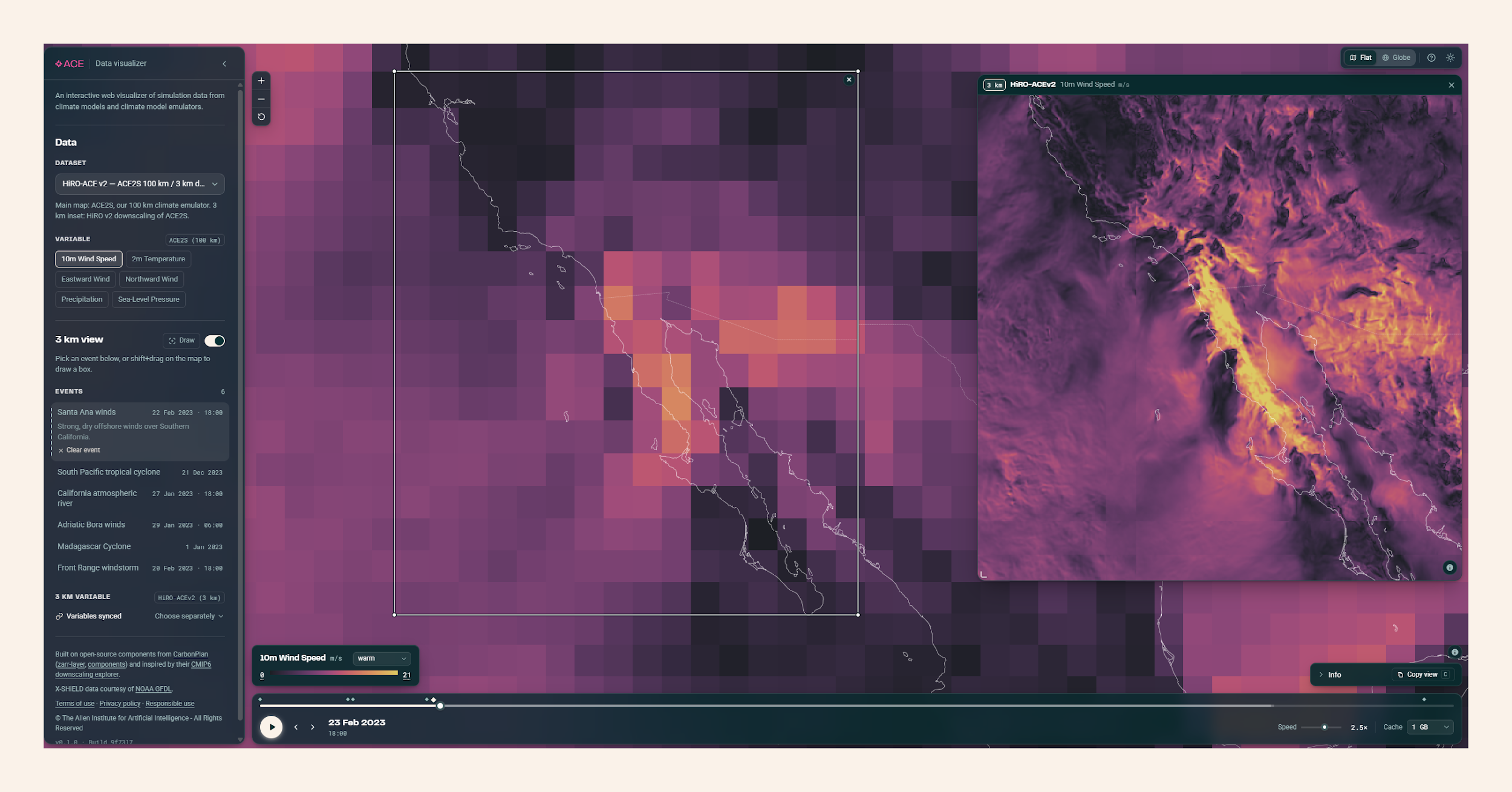
Ai2’s HiRO-ACEv2 is a climate research simulation system. It first generates global atmospheric simulations on a grid of roughly 100 km, then refines them to 3 km, aiming to represent local storms and extreme weather at a lower cost than a storm-resolving model. It does not read observations to forecast future weather. Instead, it uses AI to simulate and refine the output of an existing climate model.
The update addresses a practical tension: 100 km grids are affordable to run for many years, but smooth over local detail. Global simulations at 3 km can represent more structure, but require far more computation. HiRO-ACEv2 separates these jobs. Its goal is not merely to produce finer-looking maps, but to give researchers a more affordable way to obtain long-duration, high-resolution simulation data.
Separating Long Runs from Local Detail
The system has two models. ACE autoregressively simulates coarse-grid output aligned with X-SHiELD at 100 km, providing long-running, large-scale climate evolution. HiROv2 is a diffusion downscaling model that turns regional coarse-grid output into 3 km fields. A major change in v2 is that HiRO can generate several variables together, including precipitation, 10 m wind, and sea-level pressure, rather than handling precipitation alone.
This division assigns climate evolution over time and local structure at a given moment to separate stages. The research materials say the team improved extreme-event performance by changing training-data sampling, noise sampling, and loss weighting, and by using multiple denoisers at inference time. The trade-off is that HiRO is not a general-purpose detail enhancer: it depends on an ACE version tuned to X-SHiELD, so its input distribution and training climate constrain what it can generate.
A “Within 3%” Result Is Not an End-to-End Guarantee
Ai2 reports strong results on extremes, but the test conditions matter. When HiROv2 receives coarsened X-SHiELD data, its reported mismatch in extreme precipitation, wind, and pressure statistics is within 3%, including events that occur only once in a million data points. The paper abstract also says precipitation and near-surface wind match the reference distribution up to around the 99.9999th percentile. These results show that the downscaler can reproduce very rare statistical tails. They do not mean that the complete system predicts real-world extremes with an error below 3%.
Evidence for the full pipeline comes from a different test. Ai2 reports that an updated ACE run over 10 years aligns with X-SHiELD on hurricanes, average climate patterns, and overall distributions of precipitation, wind, and pressure. HiRO-ACEv2 also generated a year of global 3 km data from ACE-produced inputs, with overall statistics described as close to X-SHiELD. The first test mainly measures HiRO’s ability to reconstruct a known, coarsened simulation. The second includes ACE’s own simulation errors, and the public materials do not provide an end-to-end metric directly comparable to the “within 3%” result.
The Cost Advantage Scales Research, but Does Not Guarantee 300× Savings for Everyone
Ai2 says that generating global high-resolution data costs about one three-hundredth as much as running X-SHiELD; the paper abstract describes inference costs as more than 300 times lower. For a single region, the team says savings may exceed 100 times, depending on the area. The practical promise is a different research workflow: researchers may be able to run longer simulations or produce more variants at lower cost, without paying each time for a global storm-resolving run.
The public materials do not provide the full hardware setup, billing method, or workload needed to independently reproduce those cost ratios. They therefore cannot be translated directly into a guaranteed budget for any team. Region size, data movement, and inference settings can all affect actual costs. Ai2 is also working on a streamlined HiROv2 that could be more than ten times faster, but that is future work, not a performance improvement already delivered.
For Now, It Simulates Within One Climate Background
The main limit on current use is that HiROv2 learned from X-SHiELD and can only be paired with an ACE version tuned to match it. Ai2 says the system cannot yet directly generate data for a warmer future climate or work with historical products such as ERA5. The team plans to train on new X-SHiELD datasets, including a simulation of a world warmed by 4°C, and to add outputs such as near-surface temperature, snow, and ice. Those extensions are not yet complete.
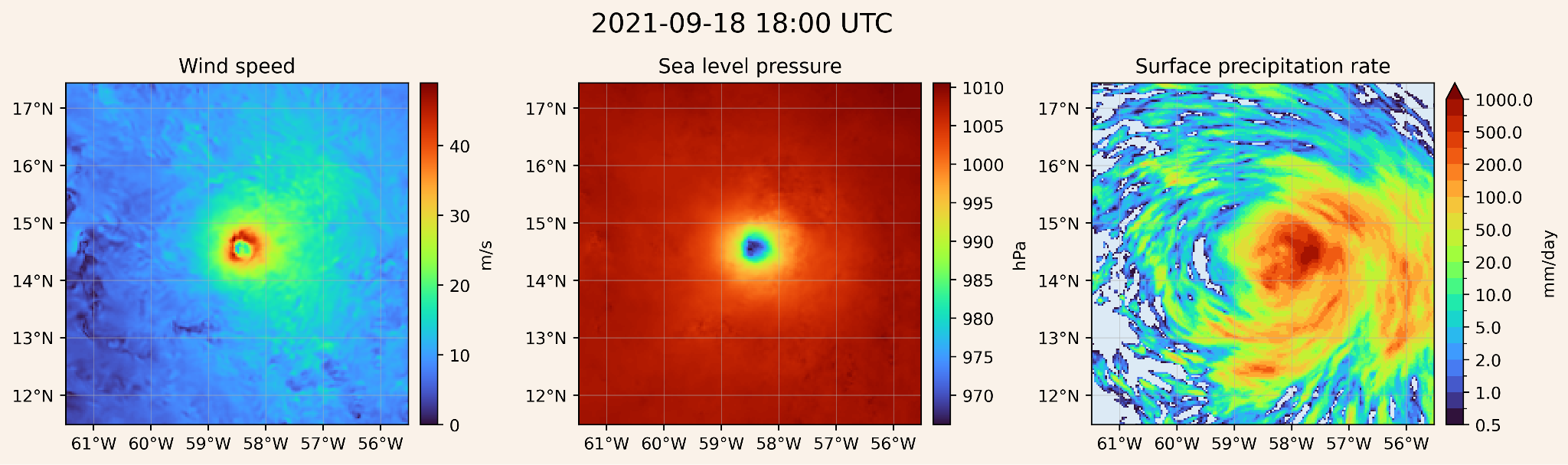
Nor do all extreme-event structures match the reference equally well. Ai2 says the generated hurricane eyes and rain bands look realistic, and that the model estimates total cyclone energy even for storms unseen during training. But winds and pressure around the eye remain more asymmetric than in X-SHiELD. For technical leaders, the sound judgment is to treat HiRO-ACEv2 as a way to scale simulations and explore extremes, not as a prediction system independently validated against real-world observations. Before using it for a particular climate background or high-stakes decision, validate it against the target variables and use case.