
Evidence at a glance
The Prize Is Not $150,000 in Cash, but a Constrained Training Window
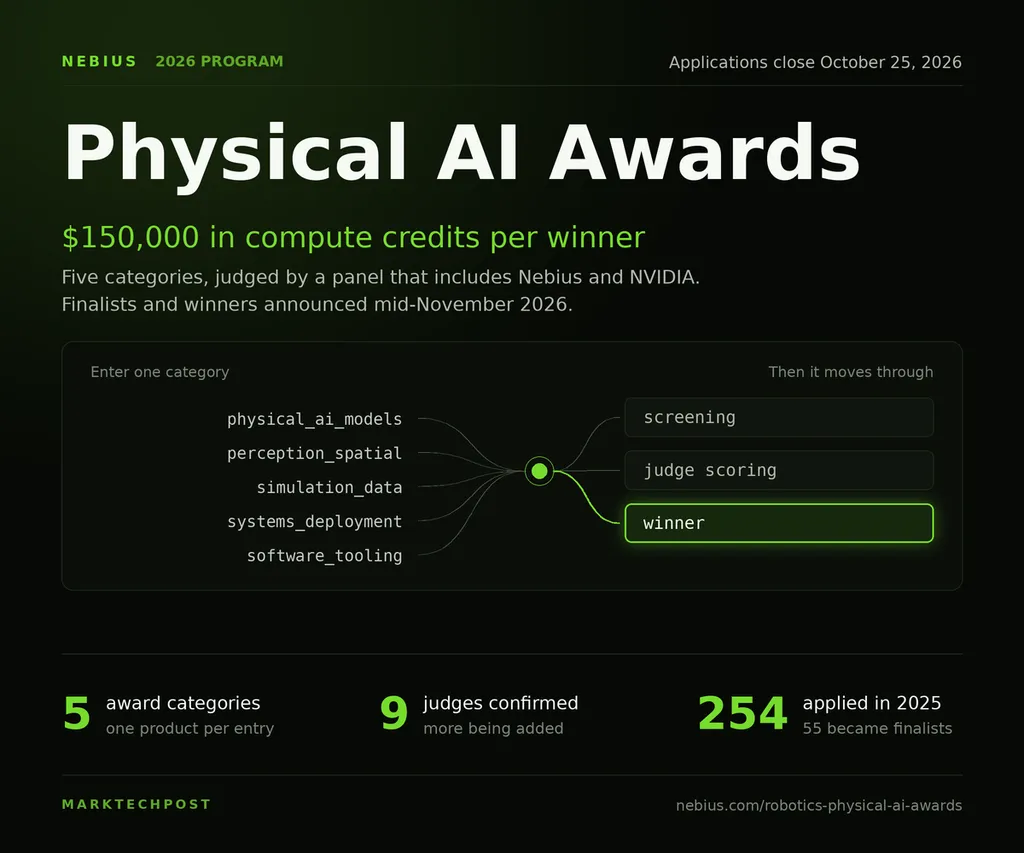
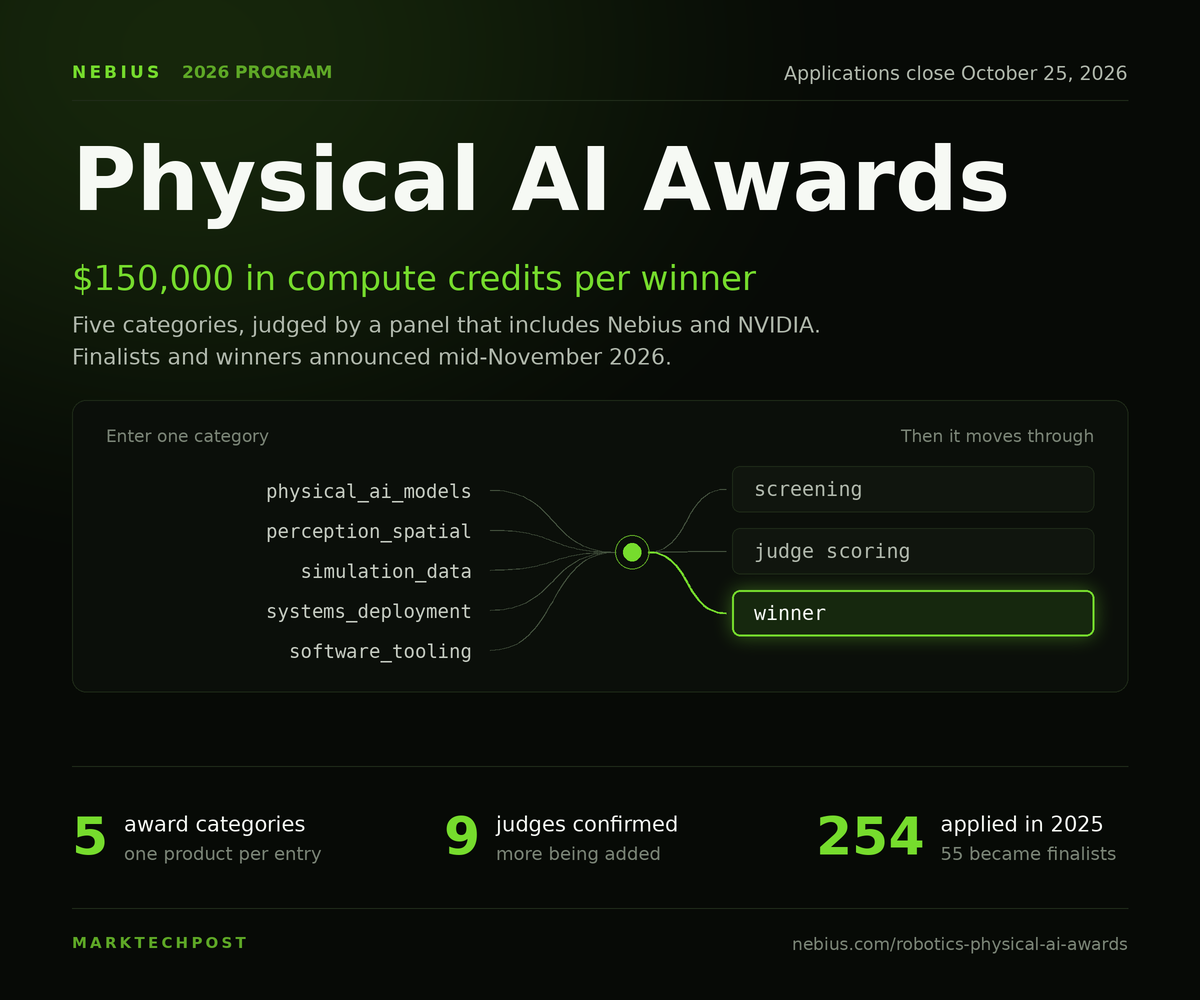
Nebius and NVIDIA launched the 2026 Physical AI Awards for startups with a clear Physical AI use case and an MVP already in use or testing. The program has five categories, each offering $150,000 in Nebius cloud compute credits. Applications close on October 25, 2026, with finalists and winners expected in mid-November. Winners also receive joint promotion, executive mentorship from Nebius, a Winners Circle feature, and two seats at an executive dinner next year.
The most misleading part of the headline is the phrase "$150,000." This is not cash that can pay salaries, buy hardware, or settle unrelated vendor bills. It is a compute budget tied to Nebius cloud usage. Based on the rates cited in the source, $150,000 at on-demand H200 pricing covers roughly 521 hours on a 64-GPU cluster, or about three weeks of continuous operation. At a preemptible rate of $2.45 per GPU-hour, it stretches to approximately 61,200 GPU-hours, which suits checkpointable reinforcement-learning and synthetic-data jobs that can tolerate interruptions. The prize is therefore closer to an immediately consumable training window than to flexible startup financing.
Why Physical AI Needs This Kind of Award Design
Once a Physical AI product is operating in the field, compute is no longer just about training a model once. Robots and automated systems generate fleet data continuously, often faster than a team can label it. Every retraining cycle must be validated before it is shipped back to hardware, and the sim-to-real loop becomes a release process rather than a research exercise. The source describes this stage as a continuous loop connecting data generation, training, validation, and deployment.
That is why the program covers a stack rather than a single robot category. Its five tracks span Physical AI models, perception and spatial intelligence, simulation and synthetic data, systems and deployment, and software, tooling, and orchestration. The final category includes middleware, MLOps, benchmarking, fleet management, and deployment tooling. The classification implies that the competitive question is shifting from whether a model can produce a convincing demo to whether a team can operate a repeatable data and deployment pipeline. Directing compute toward training, reinforcement learning, and synthetic data targets the parts of that pipeline most likely to consume budget continuously.
The Jury Reveals What Kind of Customer Nebius Wants to Select
The eligibility rules exclude pure concept projects. Applicants need a clear Physical AI use case, an MVP in active use or testing, a registered legal entity, and a live public website. Each application covers one product. Companies with several products may apply to additional categories, but the program advises them to lead with the strongest product in the single most relevant category. Entries are scored on depth of innovation, breadth of implementation, market potential, and real-world impact.
The composition of the jury is more revealing. It includes Nebius leaders in Physical AI and venture ecosystems, NVIDIA's robotics and Physical AI startup lead, a Lightspeed partner, and founders or executives from Foxglove, Voxel51, Encord, and RoboForce. Several judges run companies that sell data and tooling infrastructure to Physical AI teams, while RoboForce won the industrial robotics category in the previous edition. This does not make the process automatically neutral, but it does show what the program is trying to identify: products that operators of data, deployment, and commercialization infrastructure can understand and evaluate, not prototypes that lead only on research metrics.
This Is Ecosystem Routing, Not Unconditional Philanthropy
From Nebius's perspective, turning the prize into its own compute credits has a clear commercial logic. The application and judging process first identifies teams that have reached a product stage, then routes part of their training, reinforcement-learning, or data-generation workload onto the Nebius platform. Promotion and executive mentoring add value beyond compute, while the jury brings cloud infrastructure, data tooling, robotics, and investors into the same selection environment. The award therefore functions simultaneously as customer discovery, platform trial, and ecosystem relationship-building.
The 2025 edition received 254 applications, and 55 finalists shared $1.5 million in credits, showing that this is not a one-off marketing announcement. RoboForce, a previous winner, raised $52 million in March 2026 in a round led by YZi Labs and reported letters of intent for more than 11,000 robots. Gather AI also completed a $40 million Series B in February 2026. Nebius does not attribute those outcomes to the award. For applicants, the examples indicate possible exposure and ecosystem access, but they are not evidence that winning produces financing or orders.
Which Teams Should Apply—and Which Should Not
The program is best suited to teams with real data sources, the ability to run multi-node training, and a clearly defined compute need for the next stage. A team might be iterating policies through reinforcement learning, generating training data in simulation, or preparing periodic retraining as fleet data accumulates. For such companies, the 61,200 GPU-hours available at the preemptible rate may be more immediately useful than a smaller cash award with no usage restrictions. The jury can also help test whether the team's data pipeline, deployment process, and commercial narrative have reached a deliverable stage.
By contrast, companies with only a demo video, no MVP in use or testing, or no functioning data loop may struggle to convert the credits into product progress. Fifteen thousand dollars in on-demand pricing buys only about three weeks on a 64-GPU H200 cluster, so it cannot replace a sustained cloud budget, an engineering team, or hardware deployment costs. Applicants must also accept the constraint of platform-specific credits. The material does not say whether the credits can be transferred to another cloud provider, so they should not be treated as general-purpose compute assets. The practical test is straightforward: if the next training run is already on the roadmap and compute is the main bottleneck, the award belongs in the procurement plan. If the unresolved problem is product direction or basic feasibility, more compute will not solve it automatically.