

Evidence at a glance
The Question Is Not Intelligence, but Follow-Through
“The eternal complement,” published on the OpenAI website, is the first essay in a series about the next economy. Its authors ask a specific question: if sufficiently capable artificial intelligence arrives, will humanity mainly need more insight, or more capacity to turn insight into reality? The essay explicitly presents the authors’ views rather than those of OpenAI or its colleagues. It is not a product announcement, but an economic framework for thinking about frontier progress.
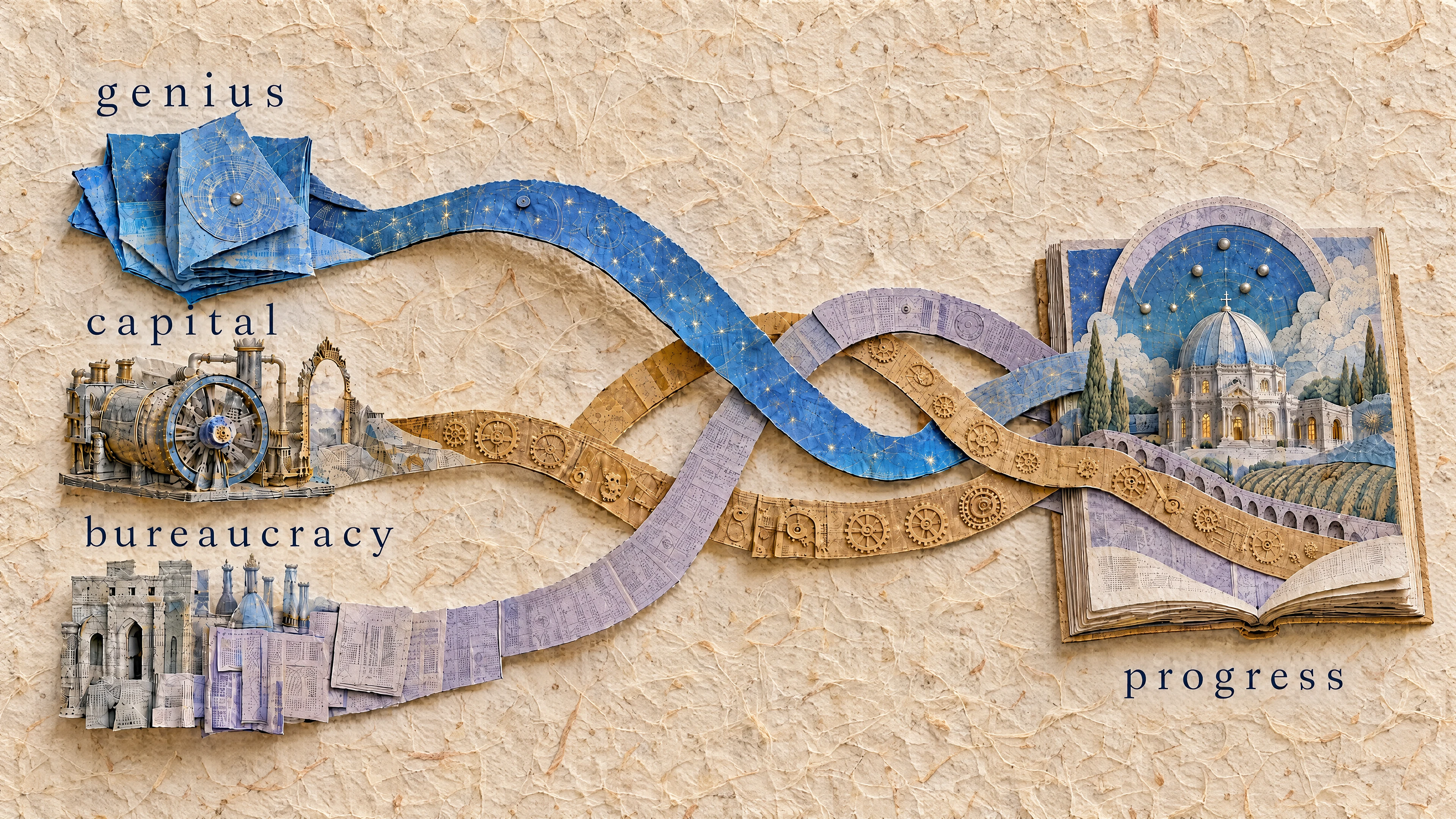
That distinction matters because discussion of AGI usually focuses on whether a model can produce better answers, write better code, or discover new theories. This essay shifts attention to what comes afterward: whether experiments can be designed and run, equipment acquired, approvals obtained, and organizations able to complete a long sequence of correct local actions. Its central claim is that frontier intelligence and the capacity to realize ideas are complements, not substitutes.
The Webb Telescope Shows Why Insight Does Not Scale Alone
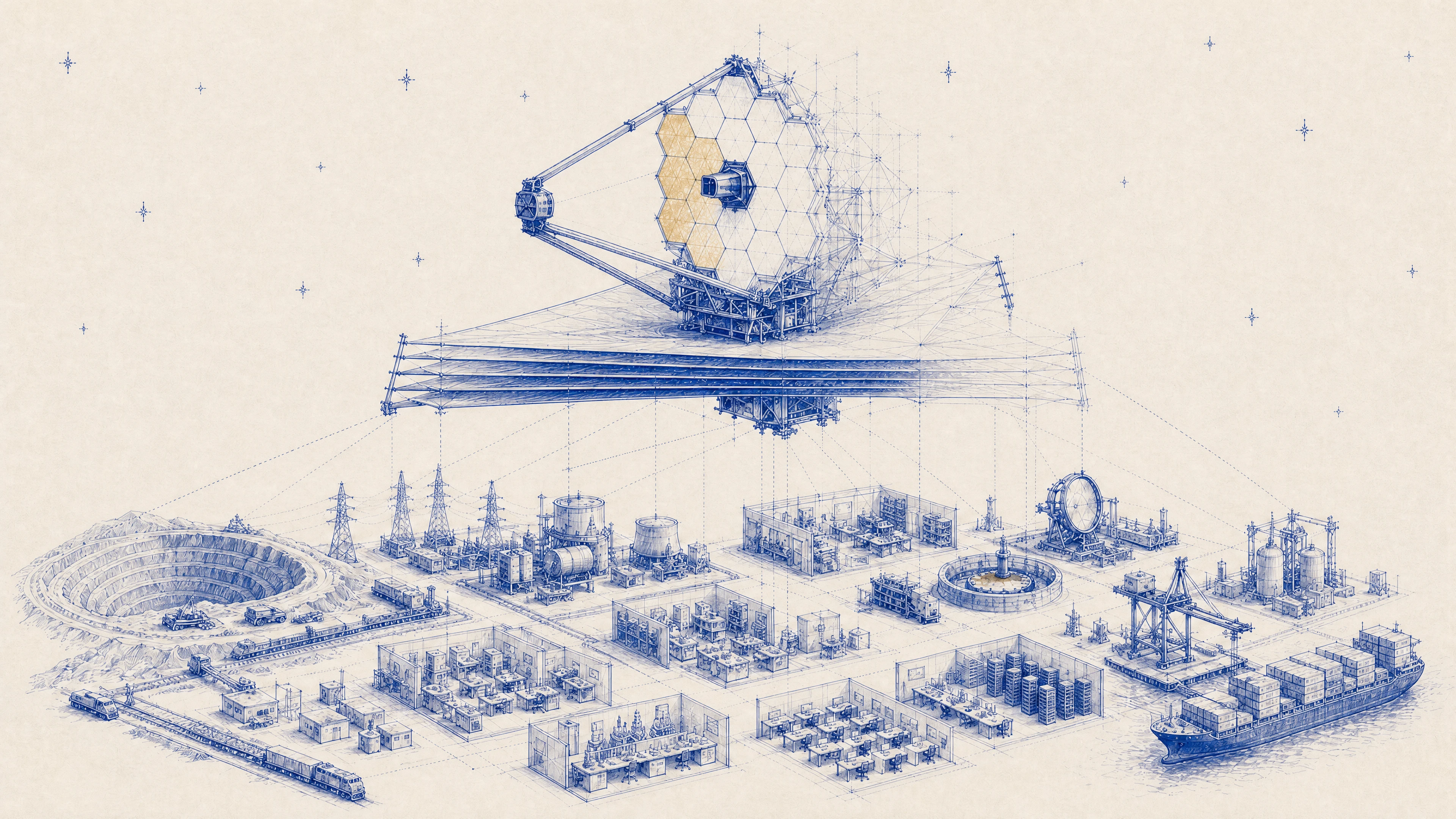
The essay contrasts Galileo’s telescope with the James Webb Space Telescope. Galileo widened human vision with two lenses and a tube, requiring only a few dozen hands. Webb cost ten billion dollars, traveled roughly one million miles from Earth, used eighteen mirror segments engineered to fifty-nanometer precision, and was built by 300 organizations across fourteen countries. What expanded was not only observational power, but also the institutional, engineering, and supply-chain machinery behind it.
The example does not make genius irrelevant. It shows that genius cannot be evaluated apart from the production process around it. A better astronomical question raises the value of a better telescope, while a better telescope makes more questions worth asking. A theory may wait on a particle accelerator, and a technical design on energy and manufacturing capacity. An idea is potential progress until evidence and execution systems carry it into the world.
Falling Research Productivity Reveals the Hidden Cost of Progress
The essay cites research by Nick Bloom and coauthors on research productivity in the American economy. Sustaining Moore’s law now requires more than eighteen times as many researchers as it did in the early 1970s. Since the 1930s, effective research effort across the economy has risen twenty-threefold, while measured research productivity has fallen by a factor of forty-one. The technician workforce has grown twice as fast as the scientist workforce, specialized scientific equipment has doubled over four decades, and a chip fab now costs five times as much as it did thirty years ago.
Together, these figures point to a structural change. Progress continues, but it increasingly depends on expanding the entire research enterprise to offset lower returns from each unit of research effort. If models only increase the supply of ideas, they may push more hypotheses, designs, and experiments into already crowded validation channels. The first failure may not be a lack of model intelligence, but the inability of schedules, data, equipment, procurement, regulation, and maintenance capacity to absorb the new demand.
Institutional Intelligence Is an Overlooked Stack
The essay calls the systems that make ideas real “institutional intelligence.” This is not a single software feature. It is a chain of mutually dependent actions: translating a question into a testable experiment, preparing the right instruments and data, securing funding and permissions, coordinating suppliers, sequencing specialist work, and feeding results back into the next decision. Each step may look mundane, yet together they determine whether frontier intelligence produces repeatable output.
That is why monotonous work is not the same as low-value work. Preparing materials, running tests, maintaining equipment, checking compliance, and following up on procurement may not look like genius, but they are prerequisites for evidence. If AI can take on parts of this chain, its value is not merely labor savings. It may increase the throughput of validation and allow individuals or small teams to pursue work that once required a large institution. Without that operational expansion, more genius may simply create longer queues.
The Practical Test: Find the Absorption Bottleneck First
The first implication for companies is not to reduce AGI investment to buying a stronger model. Technical leaders should locate the weakest link between an idea and a result: insufficient experimental environments, or the inability to run testing, data preparation, procurement, compliance, deployment, and maintenance in parallel. Once the bottleneck is visible, model improvements have a chance to become shorter feedback cycles and higher effective output rather than a larger pile of unverified proposals.
The second implication concerns evaluation. AI systems should not be judged only by generation quality or single-task success, but by whether they can operate reliably inside a real process. A system that proposes an excellent plan but cannot preserve an auditable record, use required tools, wait on external dependencies, or recover from failure remains an idea generator. A system that makes validation, coordination, and execution dependable may be closer to what productivity actually requires, even without producing a dramatic moment of apparent genius.
Neither Future Path Escapes Physical Constraints
The essay leaves open a fork in the future. One possibility is a “deep” civilization, in which stronger reasoning and more efficient instruments yield deeper understanding without a large expansion of physical activity. The other is a “wide” civilization, in which minds generate more goals but each step requires more equipment, resources, and organization, forcing society to keep enlarging its execution system. The difference is whether intelligence can substitute for real-world coordination or instead increases the demand for it.
Technical leaders do not need to settle that civilizational question today. A more actionable rule is to assess the new load on validation infrastructure whenever an AI capability substantially increases the supply of ideas and plans, then decide what should be automated, standardized, or expanded. AI can lower the entry barrier to research and creation, but it cannot erase the need for evidence, equipment, institutions, or accountability. The competition is not only to make machines think more, but to give organizations the capacity to distinguish, validate, and realize the few ideas worth pursuing.