
It Wins on Deployability, Not the Overall Leaderboard
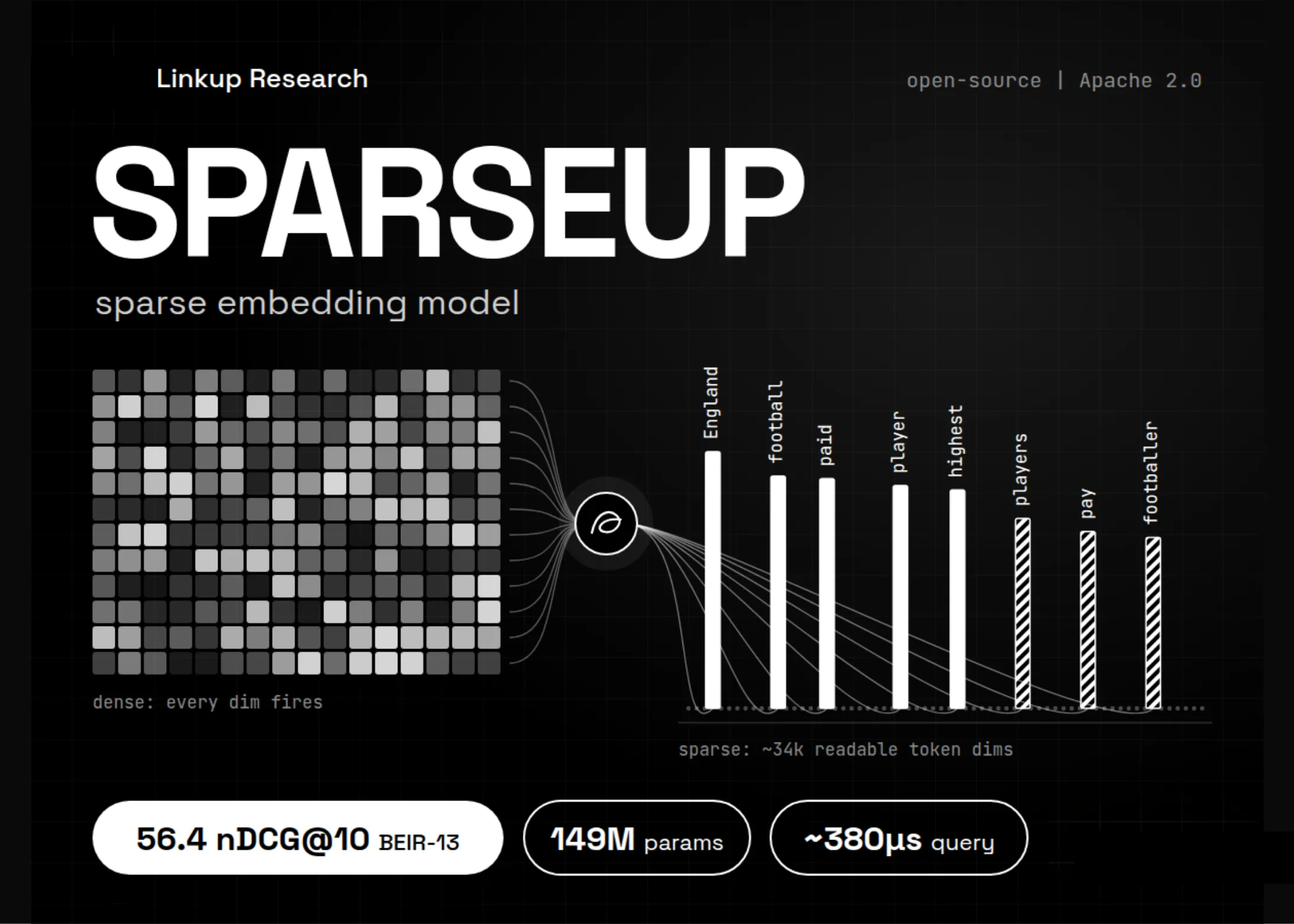
Linkup Research has released SPARSEUP, an open-source sparse embedding model built on a 149-million-parameter ModernBERT backbone. It addresses a retrieval problem that has long been dominated by dense vectors. Instead of compressing a text into one continuous vector, SPARSEUP maps it to weighted dimensions of a vocabulary. Each active dimension corresponds to an actual term, allowing the output to fit inverted indexes and making the matchable terms visible to engineers.
The release is worth reading not because SPARSEUP beats larger models on every metric. Linkup reports an average nDCG@10 of 56.4 on BEIR-13, which it describes as the strongest public vocabulary-based sparse encoder under 150 million parameters. Yet LateOn reaches 58.9 and DenseOn 57.9 under the same recipe, while the 1-billion-parameter LACONIC scores 58.7. The shift is more practical: sparse retrieval is no longer only a research branch that trades effectiveness for interpretability and indexing efficiency. It becomes a deployment option that smaller teams can evaluate seriously.
The Hard Part Is Keeping the Vocabulary from Exploding
SPARSEUP starts from a very specific construction. Linkup takes the LateOn-unsupervised checkpoint, which has no MLM head, restores ModernBERT’s original MLM head, and fine-tunes it with LightOn’s mixture using contrastive learning. Each query receives seven hard negatives sampled from a pool of 50, along with in-batch negatives. There is no cross-encoder distillation, and training fits on a single H100, making the work closer to a reproducible retrieval recipe than a leaderboard-only model.
The initial SPLADE-style approach exposed the central engineering problem of sparse models: an output can be nominally sparse while still being crowded with stopwords and weak activations. SPARSEUP applies three controls. It computes log(1 + ReLU(x - 15)) to suppress low logits, keeps only the 12 strongest vocabulary dimensions for each input token, and folds case and space variants created by byte-level BPE into one canonical term. The output vocabulary falls from roughly 50,000 dimensions to about 34,000. The model keeps vocabulary-level interpretability without allowing every input token to fan out across the vocabulary without control.
Sparsity Changes the System Interface
For a search-system owner, SPARSEUP’s most useful property is not the abstract label of interpretability. It changes the interface of the retrieval layer. Queries and documents receive [Q] and [D] prefixes, and scoring is done with a dot product. The maximum evaluation lengths are 128 tokens for queries and 512 for documents. The output can feed an inverted index while preserving direct matches for rare terms, unlike a dense vector whose evidence cannot be decomposed as easily.
The reported performance supports this positioning. With a Seismic index, SPARSEUP reaches roughly 380 microseconds per query on a single thread at more than 97% recall under the reported setup. That suggests a sparse model can sit in a low-latency recall path, but the figure should not be read as the latency of every exact inverted-index implementation because the search here is approximate. The safer engineering interpretation is that SPARSEUP offers a low-cost lexical recall path, particularly one that can be combined with dense or late-interaction models rather than carrying every semantic matching task by itself.
The Shared Recipe Makes Its Ceiling Visible
The shared setup with DenseOn and LateOn makes SPARSEUP’s ceiling more informative than an isolated score. The three retrieval paradigms use the same backbone family and fine-tuning data, which creates a relatively controlled comparison. It also exposes the cost of sparse representation: on BEIR-13, SPARSEUP trails DenseOn by 1.5 points and LateOn by 2.5 points. The gap is not simply the result of using an oversized competitor. Under similar data and training conditions, the vocabulary-sparse structure itself limits semantic expression.
The dataset pattern clarifies the boundary. SPARSEUP performs better on tasks such as ArguAna and Touché, where key terms and direct evidence matter, but is weaker on collections such as FiQA and DBPedia that depend more on semantic association. This does not reduce sparse retrieval to traditional keyword search. It shows that readable term weights and continuous semantic spaces solve different problems. Using SPARSEUP for high-recall lexical candidate generation and passing those candidates to a dense or late-interaction reranker is more consistent with the evidence than asking it to own the entire retrieval pipeline.
Separate the Two Numbers Before Deployment
SPARSEUP’s openness does lower the barrier to experimentation. Its weights are released under Apache 2.0 and are available through Hugging Face. It can be loaded with Transformers or Sentence Transformers, although the material explicitly notes that trust_remote_code=True is required. A 149-million-parameter model, single-H100 training, and output control that reduces the vocabulary space from roughly 50,000 to about 34,000 dimensions give teams a realistic way to evaluate cost and quality on their own data without first taking on large-model training expenses.
Deployment decisions should not rest on 56.4 and 380 microseconds alone. The former is an average under a specific BEIR-13 evaluation and the “best under 150 million parameters” claim is limited to public vocabulary-based sparse encoders. The latter depends on approximate Seismic search, with more than 97% recall reported for that setup. A practical evaluation should treat SPARSEUP as a replaceable recall module and measure exact recall, approximate recall, index size, and reranking gains on the team’s own corpus, query distribution, and long-tail terms. It is a credible candidate when stable retrieval of rare entities and terminology is the priority. When the main challenge is matching across different expressions, dense or late-interaction retrieval should remain central.