
Start With the Apparent Contradiction in the Numbers
Ringg is an enterprise voice and chat agent platform that grew out of customer-service operations at large consumer businesses in India. It deploys agents across phone, chat, WhatsApp, and the web to help customers buy insurance, book appointments, retrieve account information, and complete service requests rather than merely answer a knowledge-base question. According to OpenAI’s case study, Ringg now handles more than 7 million connected calls each month, agents resolve up to 65% of requests, and customers report an average CSAT of 4.8.
The important detail is that “using GPT-5.6” does not mean every request runs on GPT-5.6. Ringg says GPT-4.1 still handles most real-time voice and chat traffic, while moving suitable real-time workloads from GPT-4.1 to GPT-5.6 reduced model costs by about 90%. The change is therefore not a simple model replacement. Model selection itself has become a runtime decision inside the service system.
A Customer Request Is a Workflow, Not a Single Task
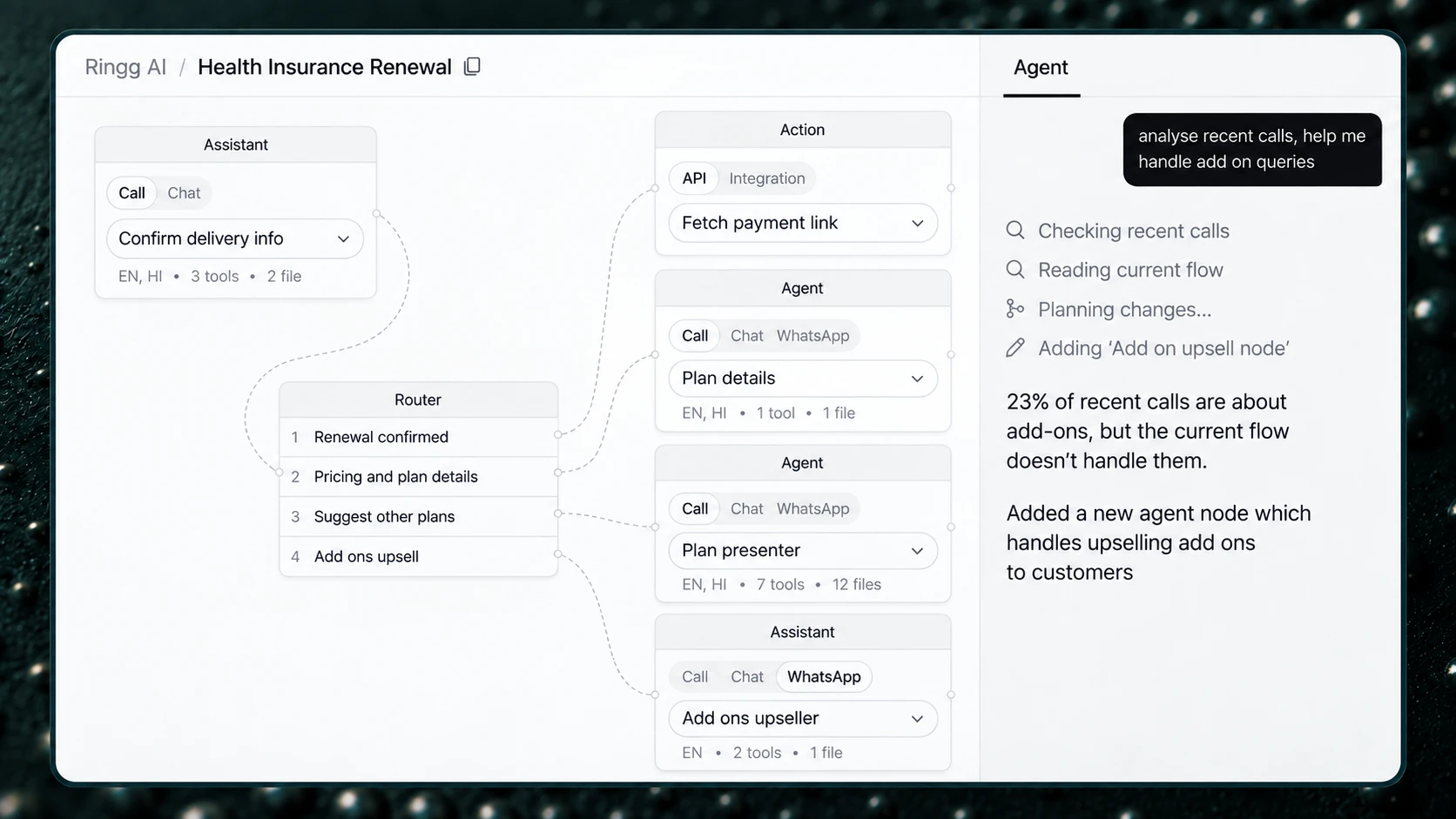
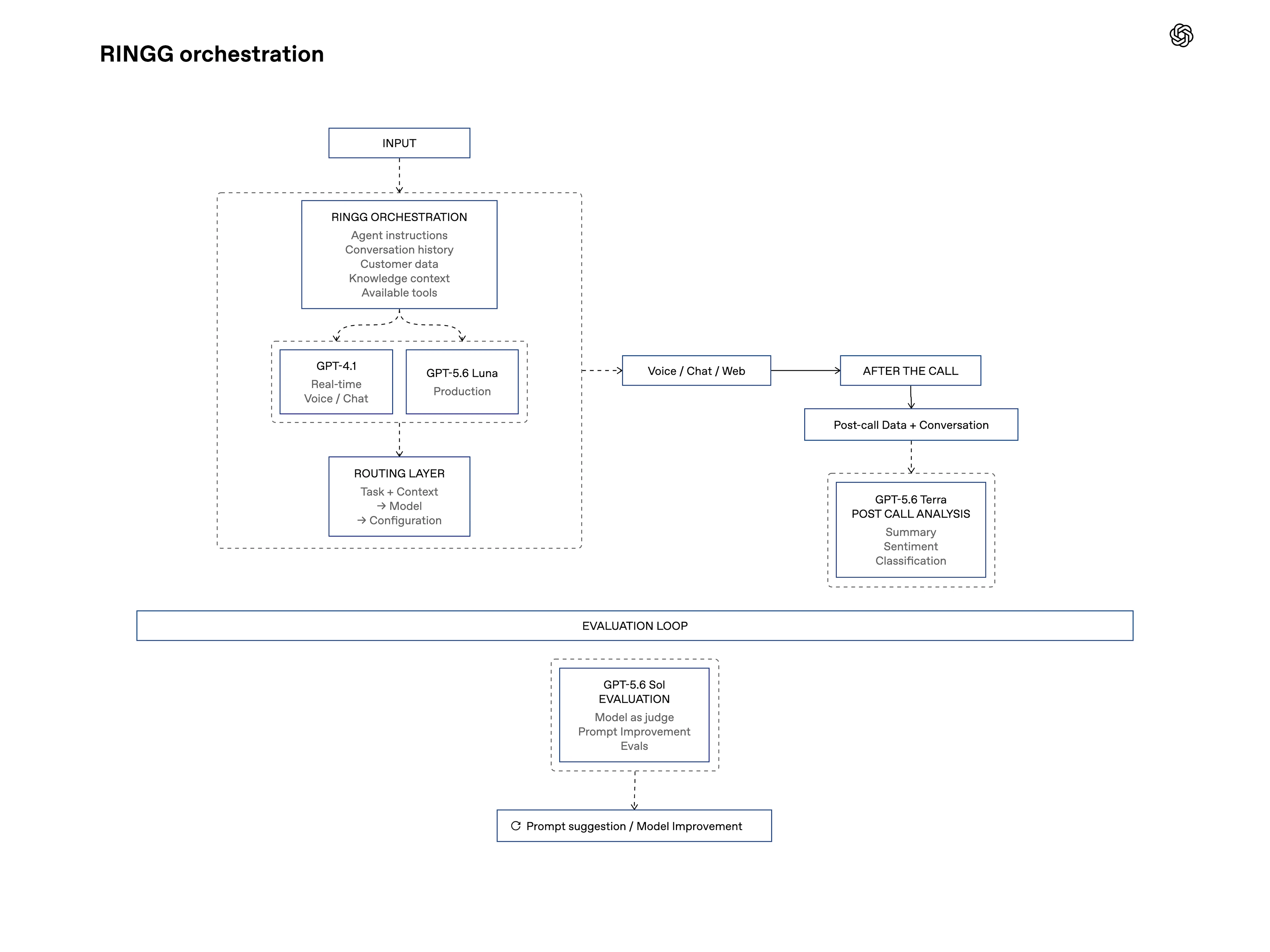
Ringg’s orchestration layer combines the customer’s input with conversation history, customer data, enterprise knowledge, and available tools before asking a model to determine the next action. A seemingly simple request may require checking a policy, retrieving an account record, scheduling an appointment, updating a CRM, calling a payment system, or transferring the conversation to a specialist when automation cannot complete it. The agent’s output is therefore not just text. It must trigger actions in external systems and bring their results back into the conversation.
This is why retrieval and tool execution are closer to the core of a customer-service system than the model’s name. Ringg’s knowledge system filters and retrieves information from structured data, PDFs, CSVs, and business documents, while its orchestration layer connects CRMs, ticketing systems, payment services, scheduling tools, and internal APIs. More complex workflows can be divided among specialized subagents for qualification, support, verification, scheduling, and escalation while the upper layer maintains a consistent customer conversation.
Evidence block | The architecture closes the loop through four steps: interpret the request, retrieve enterprise information, execute a tool action, and decide whether to complete the case automatically or escalate it. When a human takes over, Ringg preserves a summary and relevant context instead of making the customer start over.
Model Routing Solves Unit Economics Per Task
Ringg places different models at different points in the production stack. GPT-4.1 handles most real-time voice and chat traffic. GPT-5.6 Luna is used when its performance, latency, or price-performance profile is a better fit, GPT-5.6 Terra handles post-call summaries and sentiment classification, and GPT-5.6 Sol supports evaluation, prompt improvement, and model-as-judge workflows. The underlying assumption is that live interaction, batch analysis, and quality evaluation have different constraints.
This division changes how model economics should be compared. Ringg evaluates models not only on conversational quality, but also on latency, instruction following, tool calling, multilingual performance, reliability, and cost. For a customer-service platform, the cost of a request is not just the input and output token bill. It also includes retries, failed actions, human escalation, and whether the task can be completed while the customer is still engaged.
Evidence block | Three boundaries in the case must remain separate: the 90% reduction applies only to suitable workloads, 65% is an upper-bound resolution figure, and 4.8 is an average CSAT score. They describe cost, automation coverage, and customer experience respectively. They do not support a claim that upgrading the model cuts total customer-service costs by 90%.
At Scale, the Bottleneck Moves From Answers to Operations
Once a customer request becomes a cross-system workflow, reliability is no longer determined by the model alone. The orchestration layer must know which tools may be called, retrieval must return relevant and applicable business information, routing must control latency and cost, and the handoff mechanism must show human agents what the system has already done. When a longer conversation approaches roughly 80,000 tokens, Ringg creates a structured summary, indicating that context management is itself a production concern.
The deployment examples supplied with the case suggest that the strongest gains come from high-volume workflows with relatively stable procedures and verifiable outcomes. In the Policybazaar example, Ringg connected more than 57,000 customer requests, and 67% of calls reportedly required no human intervention. Average response time fell from 8–12 minutes to under 60 seconds. A separate Practo example reports an 85% first-call resolution rate, response times under three seconds, and more than 1,000 appointments completed per day. These examples show the operational effect of closing a workflow, not a universal ranking of model capability.
For technical leaders, the reusable lesson is to change what gets evaluated. Define success at the workflow level and track tool-action success, escalation rate, end-to-end latency, cost per resolved case, and customer satisfaction separately. Then use gray traffic to test whether model and prompt changes improve the total outcome. Optimizing single-turn answer accuracy will miss failures such as a correct answer that ne
The Boundary Around 65% Matters More Than the Number
Ringg’s case does not demonstrate that customer-service roles can be fully replaced. The 65% figure is explicitly an upper bound, and the platform retains a path to specialist escalation. Automation coverage therefore depends on request type, enterprise data quality, tool permissions, and risk tolerance. Even if a model understands a customer’s intent in an insurance, payment, or account-change workflow, that does not mean it should receive unlimited execution authority.
When adopting a similar architecture, the sensible starting point is a high-volume workflow that is verifiable and reversible, not an effort to hit a single automation percentage. The organization should define which actions an agent may execute directly, which require confirmation, and which must be handed to a human, while preserving auditable context for every escalation. Model routing can lower unit cost, but it cannot replace permission design, exception handling, or accountability.
The most defensible reading of Ringg’s case is that customer agents have moved from “can they answer?” to “can they complete a task under constraints?” For an existing customer-service system, build orchestration, retrieval, tool permissions, evaluation, and handoff before deciding which model should carry which workload. Only when completion, latency, cost, and risk can be observed separately for each task category does a model upgrade become a dependable operational improvement.