
Evidence at a glance
The mechanism in one line
Compress the visual or contextual input before the main reasoning path.
Route or verify the expensive step instead of repeating the full path.
Translate the mechanism into a bounded deployment or evaluation check.
Shift the Question from Humanlike to Reliable
Standard Bots targets industrial workstations for tasks such as machine tending, welding, and assembly. In the interview, co-founder and CEO Evan Beard and head of AI Leif Jentoft describe not a general-purpose humanoid intended to do everything, but a system that combines vision models, a robotic arm, and workstation control. Its concrete goal is to identify parts on a production floor and carry out bounded tasks.
The approach is worth a technical leader’s attention not because it claims broad intelligence, but because industrial deployment makes execution the hard question: What happens when perception is wrong? Are actions repeatable? Who bears the cost of downtime or rework? A model only has production value once it fits into a workstation’s operating process. Standard Bots is therefore useful for examining the system boundaries behind the label “AI robot,” not as proof that autonomous robots are already broadly mature.
Let the Model See; Let the Program Move
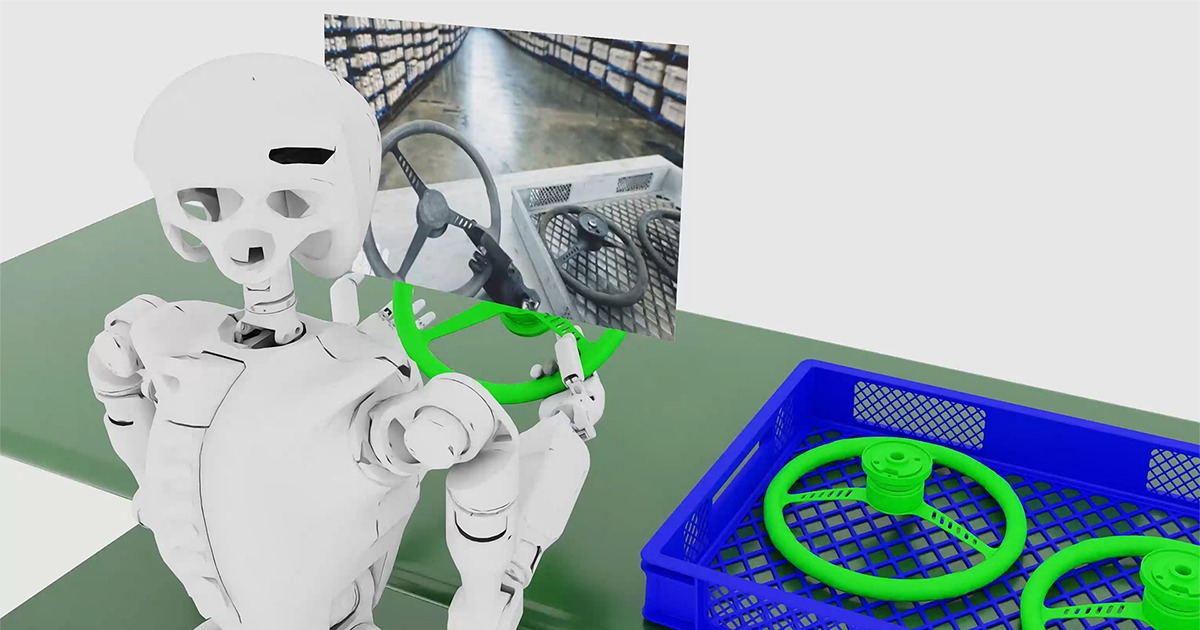
The machine-tending example in the interview draws a clear division of labor: a user specifies which part to find, the vision model locates and identifies it, and conventional programming handles robot motion and cell logic. Standard Bots says its system can identify target parts zero-shot. Jentoft also says the backbone model was trained on more than one billion images to handle differences in lighting, materials, and backgrounds. These are statements by company executives in the interview, not results accompanied by an independent evaluation in the supplied materials.
The engineering value of this separation is that the entire production workflow need not depend on a single learned policy. The material says Standard Bots focuses on short-horizon tasks to meet cycle-time and reliability requirements, while retaining conventional programming for workflow elements that do not require learned behavior. In effect, the model handles variable perception problems, while code retains the actions and cell logic that can be specified directly. Clearer boundaries make it easier to locate whether a failure came from recognition, motion, or process configuration.
The Data-Quality Claim Still Needs Deployment Evidence
Jentoft puts data quality ahead of raw dataset size and says that on-site intervention can sometimes correct an edge case with only a few dozen examples. The interview also describes Standard Bots’ largest model as being in the lower range of billions of parameters. The approach fits a common industrial constraint: the target may be a particular part, lighting condition, or workstation, rather than every possible scene. But “more targeted data” remains a strategic claim; it does not substitute for deployment results such as success rates, failure categories, and operating limits.
The public product materials establish less. Standard Bots describes Flux VLA as trained for common precision tasks in production and says customers can fine-tune it with hands-on teleoperation demonstrations. The materials also refer to improvement through the company’s development work and customer network. They do not disclose the number or duration of demonstrations, how deployment corrections are fed back into the model, or before-and-after success rates. Continuous improvement from field feedback is therefore a stated product direction, not a verified learning loop in the absence of mechanism and performance data.
Local Inference Ties the Model to the Hardware
Beard says models are trained in the cloud and run locally. In a factory, that means execution happens on site rather than requiring each action to make a round trip to the cloud. Standard Bots also says it controls the arm, end effector, control system, and AI, allowing it to co-optimize models and control policies. The important point is not the label “full stack,” but the dependency between model performance, specific hardware, and the control chain.
That integration may shorten iteration cycles, but it also makes deployment more dependent on the equipment. Performance on one setup should not be assumed to transfer to another arm, end effector, or controller. Jentoft argues in the interview that today’s models are not truly hardware-agnostic; the material contrasts this with Skild’s pursuit of cross-hardware generalization. These are different trade-offs: optimizing closely for one system may improve coordination, but the cost of adapting to new hardware still needs to be tested.
Do Not Attribute Rho’s Correction Results to Standard Bots
There is an important boundary in the evidence here. Microsoft Research’s Rho publishes more specific details about pretraining, robot adaptation, and post-deployment corrections. The model has about five billion parameters, was pretrained on more than 3,200 hours of robot data, and has three robot-adapted versions. Fine-tuning for an individual task uses roughly 100 to 300 physical-robot demonstrations. Those figures belong to Microsoft’s research, not to Standard Bots.
Rho also reports that, on a test-tube assembly task using an FR3 Duo, the success rate for the hardest configuration rose from 30% to 70% after 15 correction rounds. This shows how human corrections during deployment can form a measurable improvement path, but the result applies only to that model, task, and experimental setup. It cannot be generalized into a factory production success rate or used to fill in mechanisms Standard Bots has not disclosed. When evaluating comparable systems, ask for task boundaries, failure handoff procedures, how correction data is used, and performance after a workstation or hardware change. Without those details, “learns from the field” is not yet evidence of reliability.