


Evidence at a glance
The mechanism in one line
Compress the visual or contextual input before the main reasoning path.
Route or verify the expensive step instead of repeating the full path.
Translate the mechanism into a bounded deployment or evaluation check.
Beyond Static Retrieval: The Real Challenge of Long-Context Dynamics
Released by the Allen Institute for AI (Ai2) in November 2026, StateBench is a long-context state tracking benchmark designed to evaluate how language models maintain entity and variable states across massive documents. While legacy long-context evaluations primarily test whether a model can retrieve a static fact from hundreds of thousands of tokens, StateBench measures how well models track evolving entities. Whether following variable reassignments in code or tracking items changing hands in a mystery novel, the core challenge is continuously maintaining current states along an update chain.
This capability is fundamentally different from simple needle-in-a-haystack retrieval. While some tasks only require locating the most recent update, harder scenarios demand processing long dependency chains where a single missed step ruins the final answer. As vendors continuously expand context windows, developers urgently need a tool to measure state-tracking limits systematically rather than relying on generic throughput claims.
Four Difficulty Tiers: From Immutable Assignment to Finite State References
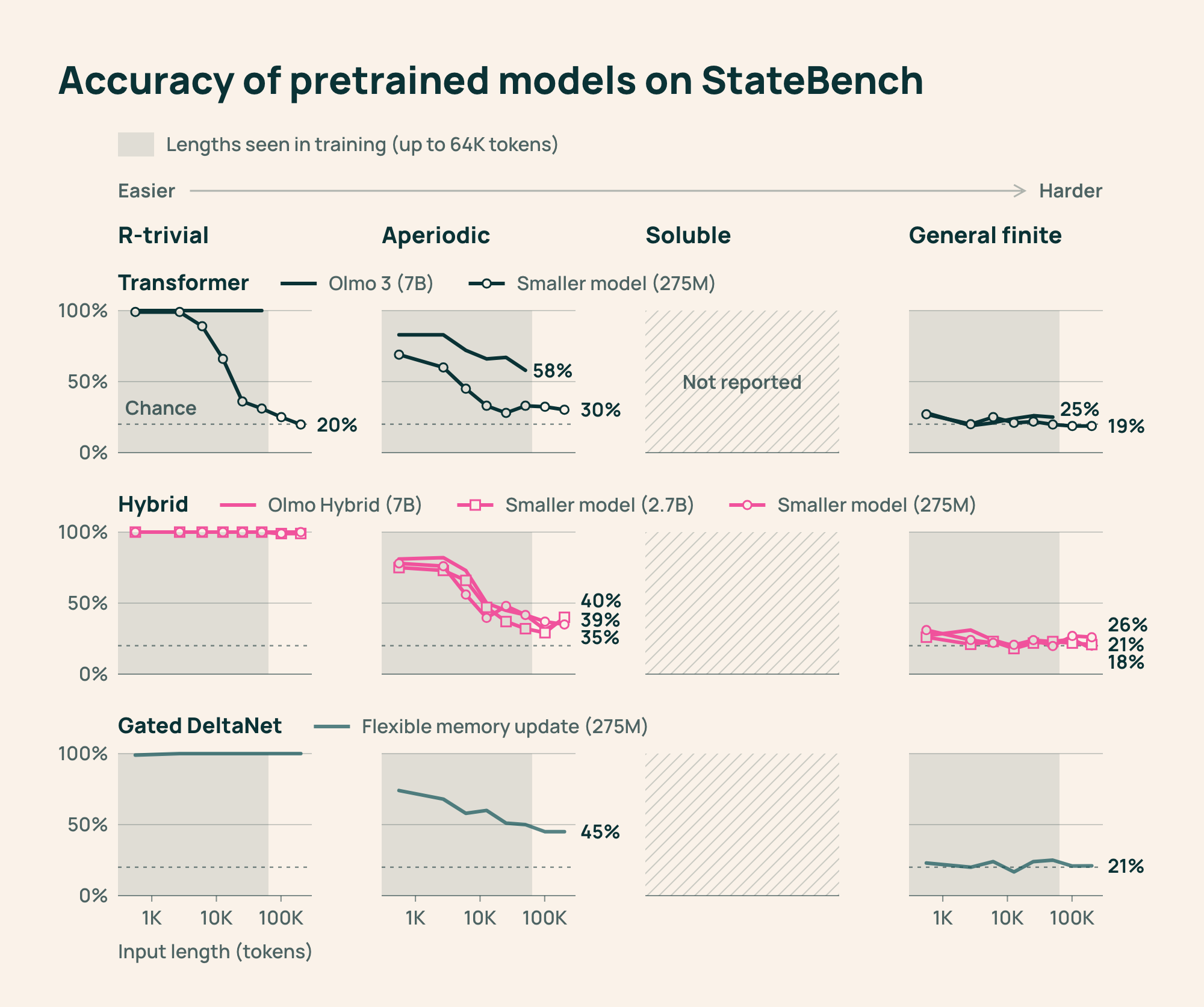
StateBench categorizes state-tracking problems into four difficulty levels mirroring variable assignment operations in computer science. The simplest, r-trivial, resembles immutable assignment where a variable's value never changes. The second tier, aperiodic, allows reassignment by value, requiring the model to find the most recent value while ignoring history. The third tier, soluble, introduces self-referential updates where each change builds on the current value, much like accumulating game scores. The hardest, general finite, introduces assignment by reference and cross-swaps, demanding the tracking of cross-variable dependencies.
To formalize these programming concepts mathematically, the benchmark grounds its design in Krohn–Rhodes theory from algebra, treating state-tracking problems as word problems over finite monoids. To maintain controlled variables, researchers first generated general finite-state update sequences and then translated them into four difficulty versions, presenting each underlying task across six text formats including integer code, spreadsheet cells, and block coloring. This design eliminates format bias and tests underlying logical tracking mechanisms.
The Breakdown of Frontier Models: Accuracy Cliffs at Scale
Evaluating frontier closed-source models and mainstream pre-trained models reveals pervasive performance boundaries. According to Ai2's findings, when inputs reach between 10K and 64K tokens, frontier models experience sharp performance degradations down to near-random levels on soluble and general finite tasks. The blog notes that on the longest general finite tests, top models see their accuracy drop to 13% or lower.
This demonstrates that current closed-source giants still lack robust internal computation mechanisms when confronting long-range, complex state dependencies. As contexts grow, attention mechanisms and limited hidden states fail during multi-step interleaved updates. While models may correctly handle early assignments, accumulated errors completely derail final reasoning outcomes after dozens or hundreds of state transitions.
The Architectural Divide: Generalization Bounds in Recurrent and Hybrid Designs
Beyond evaluating existing models, the research trained different architectures directly on StateBench, comparing Transformers, Gated DeltaNet (GDN), and hybrid designs. Experiments show that when trained directly on these tasks, recurrent and hybrid models exhibit vastly superior length generalization compared to Transformers. A 275M-parameter GDN variant generalized to roughly 10 times its training sequence length on the hardest general finite tasks before degrading.
In contrast, traditional Transformer architectures failed to learn the training distribution tasks at the hardest level. GDN variants with positive and negative eigenvalues carry forward running memory, handling cross-variable references and state rearrangements more effectively. This proves that architectural choice directly dictates whether a model can sustain long-range dependencies via recursion or state propagation rather than simply stacking attention layers.
Engineering Implications: Assessing the True Costs of Long-Context Workloads
For engineering teams deploying LLMs in codebase analysis, complex state-machine maintenance, or long-form reasoning, StateBench offers a clear warning. Developers can no longer rely on advertised maximum token capacities as a metric for system reliability. When production workloads involve frequent variable overwrites, state accumulations, or multi-object references, the probability of hallucination or logic collapse skyrockets after tens of thousands of tokens.
When selecting infrastructure, internal architectural traits take precedence. If business scenarios involve heavy state evolution and strong dependency chains, relying solely on Transformer architectures hits a natural generalization ceiling, making hybrid or recurrent architectures with explicit memory maintenance vital. Engineering teams must conduct tiered evaluations of long-context workloads in production, strictly defining the upper bound of state update steps a model can handle reliably.