


Evidence at a glance
From Laundry-Folding Demos to a Petri Dish
Ai2 published ToyBlocks on the Hugging Face blog and placed it inside a larger framework called FoundationWorlds. The goal is not to build a stronger robot directly, but to give robot learning a kind of controlled simulated world: each world targets a specific environment, comes with tools that automatically generate tasks and demonstrations, and provides metrics for observing robot behavior over time. The first world, ToyBlocks, centers on a robot arm and a set of blocks on a tabletop.
This release is worth a technical leader's attention because it responds to a methodological problem rather than a capability one. The post opens with a status quo: robots are learning to fold laundry, sort parts, and handle unfamiliar objects, but those demonstrations are often narrow and neither explain what the robot has learned nor why it fails. ToyBlocks is positioned as a repeatable testbed with controllable variables for exactly those questions.
Four Requirements and a Deliberately Narrow Scope
ToyBlocks is designed around four requirements: realistic physics and appearance, automatic generation of tasks and demonstrations at scale, challenges that combine reasoning with dexterity, and broad coverage of the tasks possible within a domain. The post explicitly acknowledges that open-ended domains require modeling a wide range of objects and interactions, making it infeasible to satisfy all four at once; ToyBlocks' narrow scope is what makes satisfying all of them possible.
That is an important tradeoff signal. It does not claim to be a general robot benchmark; it chooses to make a simulated arm and blocks behave very similarly to their physical counterparts within a small world. Coverage is deliberately surrendered in exchange for confidence in physical fidelity and controllability of task generation. For readers, this means ToyBlocks conclusions are better suited to mechanistic questions than to cross-scenario capability rankings.
Demos Without Teleoperation: Training Data Becomes a Tunable Variable
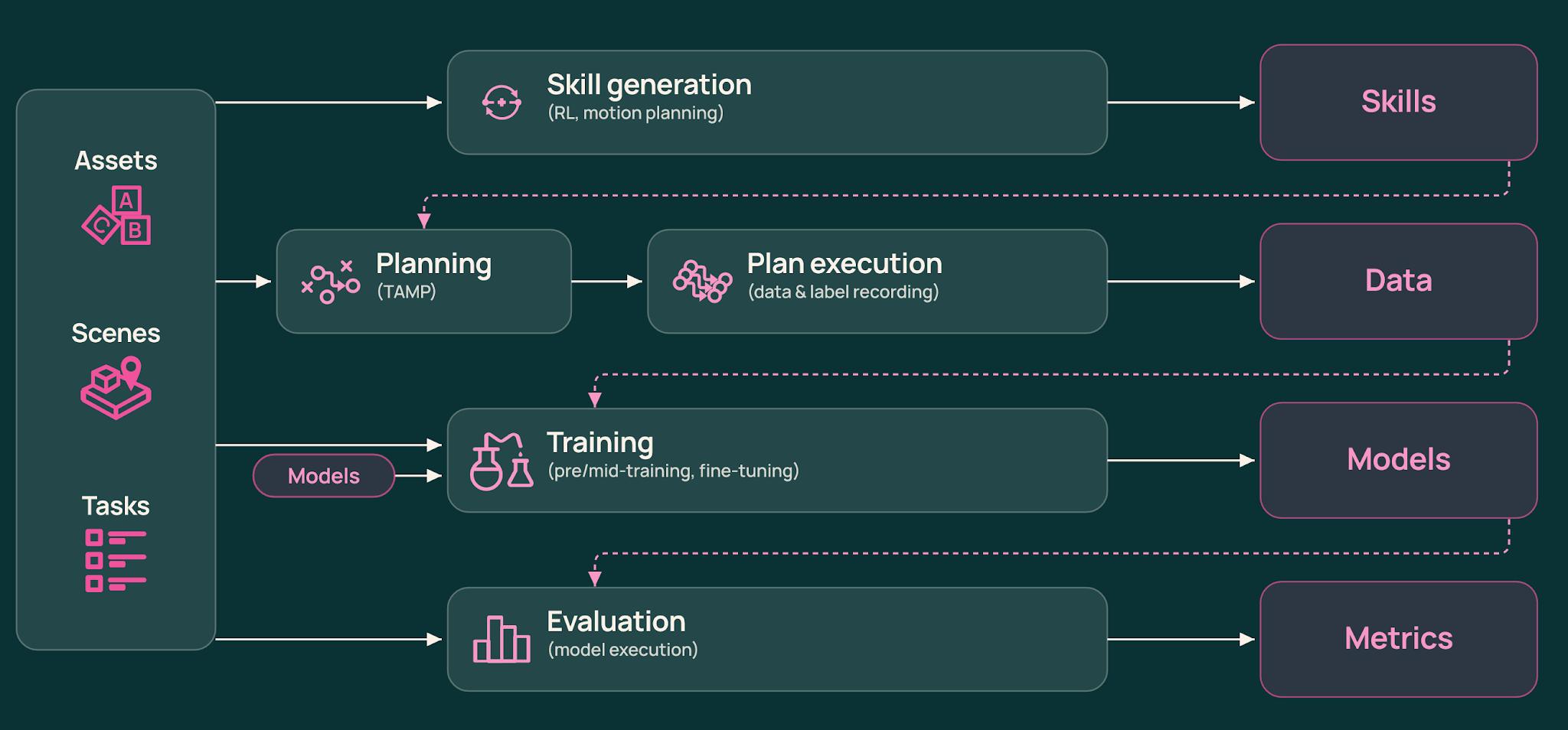
ToyBlocks automatically generates demonstrations, recordings of a robot completing tasks in simulation, without time-consuming human teleoperation. That changes the shape of experiments: a team can generate more pushing, flipping, or stacking demonstrations and then evaluate on tasks held out of training. The distribution of training experience thus turns from a fixed dataset into a dial that can be turned.
Mechanically, the framework uses reinforcement learning and motion planning to generate skills for short-horizon tasks, with skill training taking place in Isaac Lab. Through trial and error, these policies learn non-prehensile skills such as pushing, flipping, and stacking. Meanwhile, high-level reasoning models decide what to do and low-level action models control how the arm moves. This layering lets researchers change the reasoning side or the control side separately and then observe which layer a failure occurs in.
Letters on Block Faces: Where Reasoning Meets Dexterity
ToyBlocks is not just about picking and stacking. Pictures and letters on block faces enable searching, sorting, and arranging tasks. A robot may need to turn a block to see a hidden face before deciding where it belongs. This design binds high-level semantic judgment and low-level physical manipulation into a single task rather than evaluating them separately.
Another variable is domain randomization: varying block size, table height, and other physical properties from scene to scene to test how well models generalize as geometry changes. This is closer to real-world distribution shift than a fixed-scene evaluation, while remaining controllable. For embodied-AI teams, the setup offers a way to disentangle failures: does the model fail because it cannot understand the task, or because control becomes unstable under changing geometry?
What It Means in Practice: Ask About Attribution Before Capability
If a team is working on robot learning, the most direct use of ToyBlocks is not to chase a high score but to treat it as a hypothesis-testing tool. The post explicitly says the framework can be used to design experiments and validate hypotheses, including additional training of previously trained models to adapt to new tasks. A workable loop is: fix the model architecture, change only the demonstration distribution, and watch how performance curves shift with data volume; or fix the data and change only how high-level reasoning and low-level control are combined.
That also changes the role of metrics. They are no longer just final success rates but signals for observing robot behavior over time and locating failure modes. For a technical leader, this means moving evaluation design to the start of a project rather than bolting on a benchmark after training. ToyBlocks supplies experimental infrastructure, and its value depends on whether a team is willing to decompose problems into controllable variables.
Boundaries: Conclusions From a Small World Do Not Travel Directly
ToyBlocks' boundary is the same thing as its strength: narrowness. Because it covers only a robot arm and blocks on a tabletop, it can simultaneously achieve physical fidelity, automatic task generation, and challenges that combine reasoning with dexterity. But that also means conclusions from this world cannot be directly extrapolated to laundry folding, parts sorting, or messy real scenes. The post calls it the first FoundationWorld and says the aim is to extend the approach to increasingly complex environments, which itself indicates the current version is a starting point.
A more defensible judgment, then, is to treat ToyBlocks as a controlled environment for studying causal mechanisms and failure attribution, not as a general capability certification. It builds on Ai2's earlier open robot learning work, including MolmoAct 2, MolmoBot, and MolmoSpaces, and is positioned to let researchers ask questions clearly within a deliberately constrained domain. What bears watching is whether, as the approach extends to more complex worlds, the tradeoffs among the four requirements become irreconcilable again.